White Sands Missile Range
Recently, I had a chance to join the Las Cruces Chapter of the Native Plant Society of New Mexico on a field trip to the White Sands Missile Range (WSMR). The draw for me was two-fold. The opportunity to be around people who knew a lot more than I do about something I am interested in was important. I enjoy photographing plants, but I do not have the technical expertise of the other people on this outing. Secondly, the WSMR is generally a restricted area with access granted only in special circumstances. I have only been on the range on one other occasion, on a visit to Lake Lucero to photograph selenite crystals at that location.
On September 21, 2019, tour participants met in Las Cruces. From there we headed to the entry gate just north of US-70, to await our WSMR guides. Our wait provided a great opportunity to photograph the Organ Mountains.
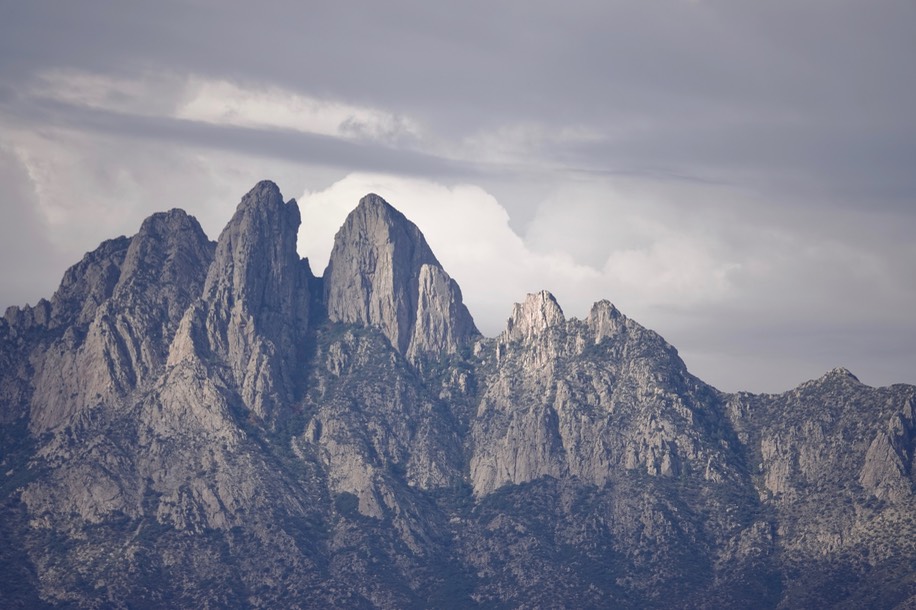
The Organ Mountains from the East
From the gate we traveled north along the eastern border of the San Andres Mountains and then west into Rhodes Canyon and the gravesite of Eugene Manlove Rhodes. Our travel was by a convoy of personal vehicles with WSMR personnel at the front and the back of the cavalcade. We stopped only so one of the vehicles could have a tire changed and at outhouses so the humans could remedy their ails.
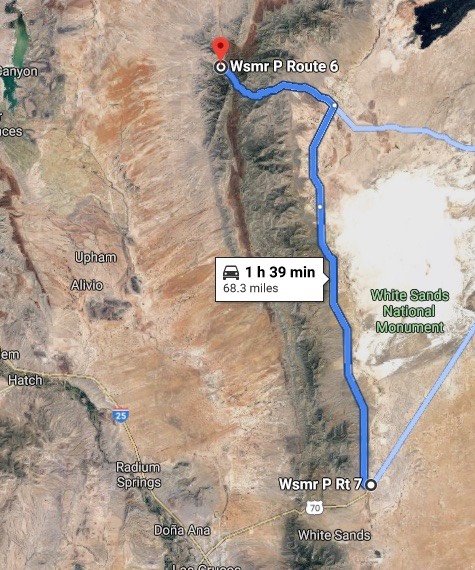
WSMR is an area of significant botanical interest. Vegetation of White Sands Missile Range, New Mexico Volume 1 and Volume 2 are helpful reading for anyone interested in visiting the area. They describe the numerous plant communities found on the Range.
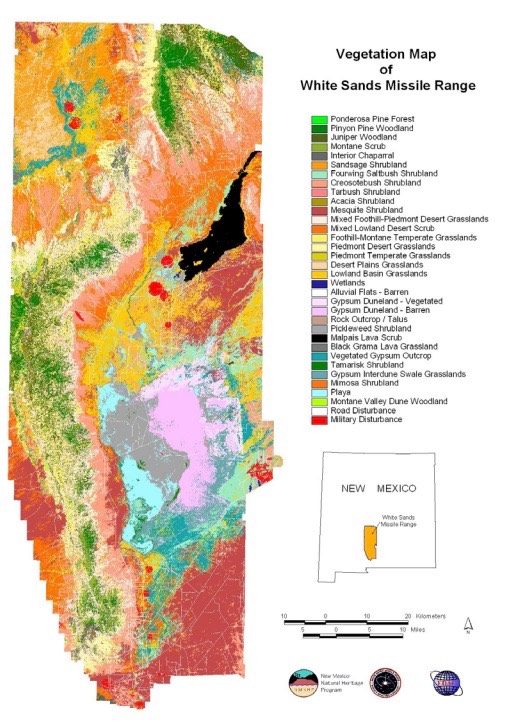
The Vegetation of White Sands Missile Range, New Mexico
Volume 2, page 15, Esteban Muldavin, Glenn Harper,
Paul Neville, and Yvonne Chauvin, 2000
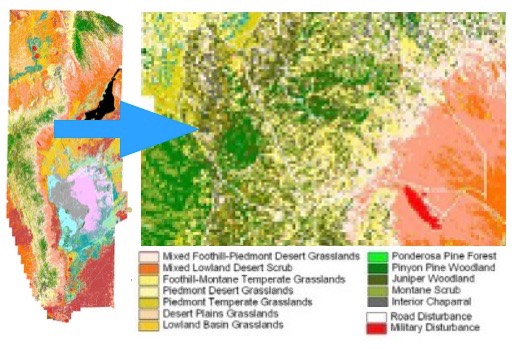
Detail of the area we visited.
The San Andres are geologically and botanically different from the Organ Mountains to the south. The Organ Mountains are angular and composed of intrusive granite and rhyolite flows. The San Andres Mountains are “softer”, more rounded, being formed as part of the Rio Grande Rift Valley. The San Andres are west-dipping fault blocks of sedimentary strata, mostly limestone.
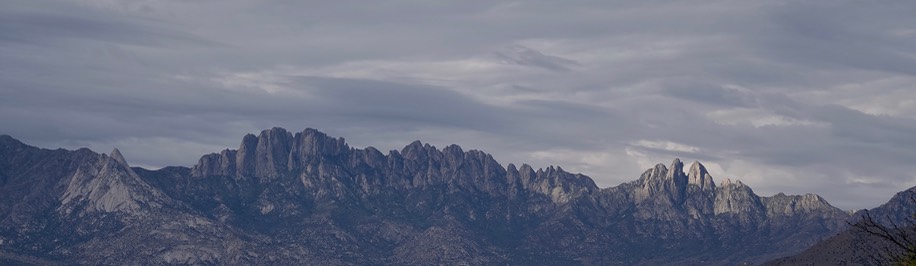
The Organ Mountains from the East
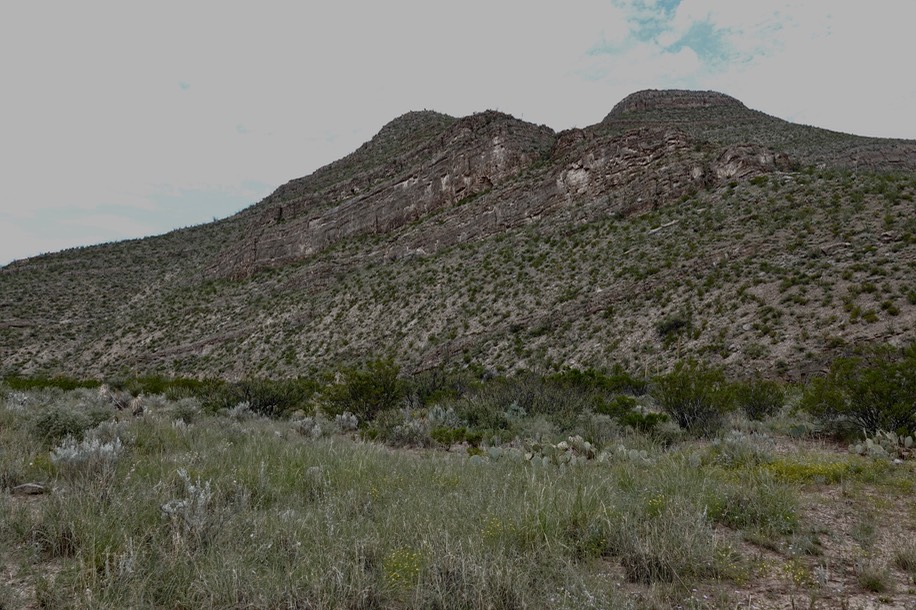
Limestone strata in Rhodes Canyon
On the mammal front, the highlight of the trip was the four Oryx standing beside the road on the drive back.
Special thanks to the Native Plant Society of New Mexico, Las Cruces Chapter, and to John Freyermuth in particular. Dr. David Lee Anderson led the tour, he is the former rangeland manager for the missile range and has a wealth of knowledge. His public service in leading such tours is both noteworthy and laudatory. John and David have compiled a (tentative) list of plants seen on this outing, see attached.
In addition to the species depicted to the left, there were many other plants identified during the outing, including Anoda cristata, Oenothera hartwegii, Psilostrophe tagetina, (possibly) Opuntia camanchica, Machaeranthera tanacetifolia, Sphaeralcea polychroma, and Glandularia bipinnatifida. Any errors (please report them to me) are solely my own.
Trinidad & Tobago
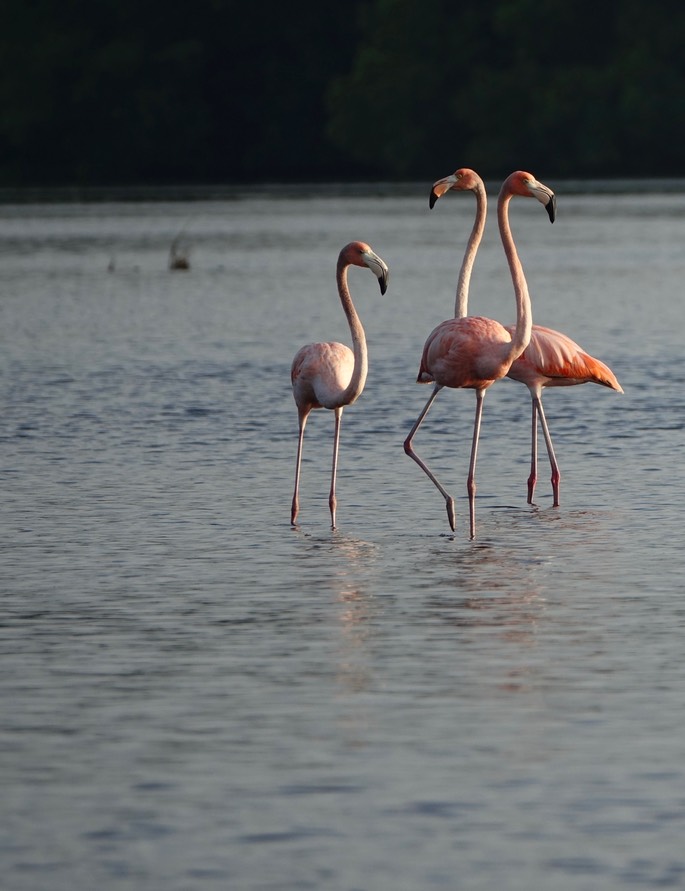
American Flamingo, Phoenicopterus ruber,
Caroni Swamp, Trinidad
During the first two weeks of April (2018), I returned to Trinidad & Tobago for the third time. This time, Rebecca joined me and I promised her a “birding lite” experience. None of this before dawn to after dusk, and a bit of midnight, birding stuff - nope, this would be a soft trip. I really wanted to show her the islands.
Our trip started with a seven-hour delay in our flight out of El Paso and a forced overnight in Houston, but United Airlines was on-time the rest of the time. (I must admit, however, that the opportunity to buy a snack on a five and a half our international flight is nowhere near what I call service.)
We booked our “independent” travel through Caligo Ventures. Their support was excellent and the arrangements they made worked flawlessly. In this context, “independent” simply means that we were not on a tour. The two of us traveled by ourselves but all of the lodging, flights, and land transport were arranged by Caligo.
We arrived in Trinidad at about 9 p.m., a driver from Asa Wright was there to transport us to the Nature Center and our trip began in earnest. This was my third visit to Asa Wright and our five-night stay proved to be up to standard, a high standard. I did video from the verandah and along the trails including a tour to the Oilbird grotto. The number of birds in the grotto was significantly less than the number I had experienced in previous visits.
We took a day trip to Caroni National Park and saw the usual array of staked out critters . On this occasion we had Masked Cardinal (recently split from Red-capped), Tropical Screech-Owl, Cook’s Tree Boa (not to be confused with the ‘other’ Cook’s Tree Boa), Boat-billed Heron, and Silky Flycatcher. We also enjoyed a flock of American Flamingos. We had seen this species a couple of years ago in the Yucatan and the other three species found in the Americas almost two decades ago in Chile. And, of course, the Scarlet Ibis fly-in. That was the purpose of the boat ride through the mangroves and it did not disappoint. Interestingly, in my three visits to the swamp to see this daily event I have yet to take a photograph I am really pleased with. Boat rides through the mangroves can be crowded but on this occasion there was the boatman, our driver, and six tourists - a much more enjoyable experience than sitting on one of the six boat benches four across.
From Asa Wright we travelled to Mt. Plaisir Lodge in Grand Riviere, on the north coast of Trinidad. This was my first visit to this location. The hotel is right on the beach and the sound of surf lulls you to sleep every night. On the first morning, the hotel owner took us a short way up the road south of town to an estate with a caretaker named Peter, to see Trinidad Piping-Guan. There was a tour in the area at the time of our visit; they drove up to the site and birded from the road, while we were there. In our case, the hotel owner pays Peter a bit and we were allowed onto the grounds. Peter explained the natural history of the Guans and his efforts to (successfully) restore the population by providing suitable habitat. We spent over an hour there taking video and watching. Peter harvested coconuts for the three us and we had fresh coconut juice and meat, scraping the white manna from the shell with a bit of coconut husk.
The beach at Grand Riviere is a turtle reserve. It is possible to make arrangements to walk the beach at night with the researchers. Arrangements are made next door to the lodge. We were at Mt. Plaisir for three nights and chose to skip an outing on the first night because we would be up early for the Piping Guan the next morning. At this time of year Leatherback Turtles are coming up on the beach to lay their eggs, and the number of people on the beach can be significant. We went out on our second night there and had the beach to ourselves (and the researchers and many turtles). The turtles are massive, incredibly clumsy on land, and driven. It was a very moving experience.
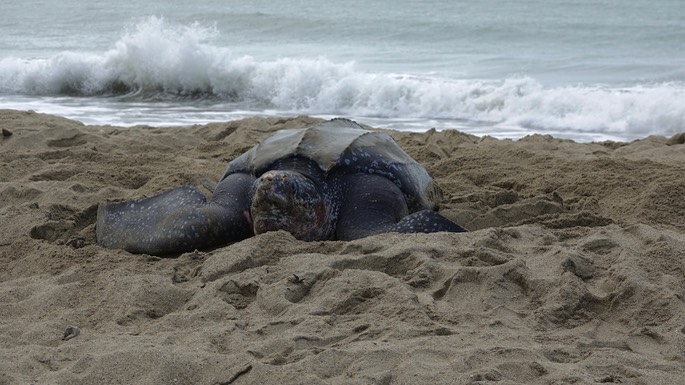
Leatherback Sea Turtle, Dermochelys coriacea, Grand Riviere, Trinidad
Leatherbacks are impressive creatures. They can weigh up to 1,500 pounds and be seven feet long. They use their front flippers to move (very slowly) about the beach and their hind flippers to dig out the hole in which they deposit their eggs. It is my understanding that they are as graceful in the water as they are clumsy on land. Some of the turtles came ashore during the day. I look forward to the start of the editing of video from this trip, sometime in May, in large part because of the turtle video.
Next door to the Mt. Plaisir Lodge, at the same location where you can get beach permits to watch turtles, there is a kitchen business which makes chocolate. One of the cooperative members demonstrated the chocolate making process to us, we tried a few samples, and then we were served cocoa tea (what we would call hot chocolate - but not any hot chocolate, the best that I have ever had). It was apparent that he had a canned presentation and he dutifully went through it, never deviating from the standard line even though Rebecca and I were the total “audience”. Afterward, however, we enjoyed our cocoa tea and talked with him and a cocoa grower who stopped by, at length, a great experience all the way around.
We really enjoyed the food and lodging at Mt. Plaisir - and the staff were friendly, competent, and helpful.
From Grand Riviere, we travelled to Piarco International Airport, took the short flight to Tobago, and onward by car to Cuffie River Nature Retreat. I had stayed there in January of 2016 and enjoyed it immensely. We spent three nights at Cuffie, and enjoyed the food, the birds, and the service.
During our stay I managed a good bit of video, including Common Potoo during the day - a significant improvement over the material I recorded there previously of a bird at night. I did get up one night to take photographs of the White-tailed Nightjar which is a regular at this site.
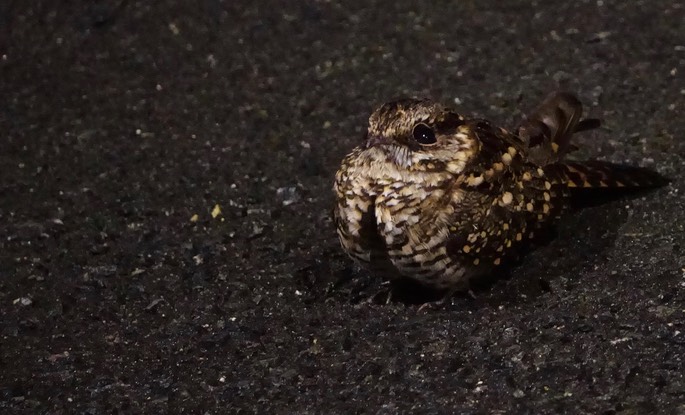
White-tailed Nightjar, Caprimulgus cayennensis leopetes, Cuffie River Nature Retreat, Tobago
From Cuffie we travelled to Blue Waters Inn where we spent three nights. This was my third stay at Blue Waters. My first stay there was in the late 1980’s as part of my first international birding tour. At that time it was a little place on the beach, totally charming. Now it is my least favorite of the places we stayed. I find it conventional, but the rooms and food are good and it provides access to Little Tobago Island and to St. Giles Island - both to be visited!
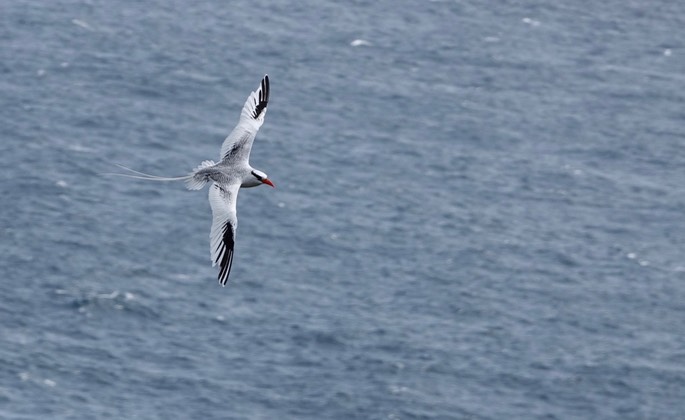
Red-billed Tropicbird, Phaethon aethereus, Little Tobago Island
The ride to Little Tobago Island is on a glass-bottom boat which affords some nice views of the reef around Goat Island, which lies between Blue Waters and Little Tobago. Getting on and off the boat at Little Tobago can be a bit tricky if the seas are rough - perhaps downright dangerous. On my first visit, I was enchanted by the Red-billed Tropicbirds flying by, on my second visit (in 2016) I photographed nesting Red-billed Tropicbirds, and on this visit I was able to show Rebecca both - just the two of us and a guide.
On my last visit to Tobago I took a fast boat to St. Giles Island, from Blue Waters, to see the nesting Frigatebirds and Boobies. On this trip we took a short ride over to Charlotteville and took a boat to St. Giles from there. On this trip, twins from England joined us for the ride.
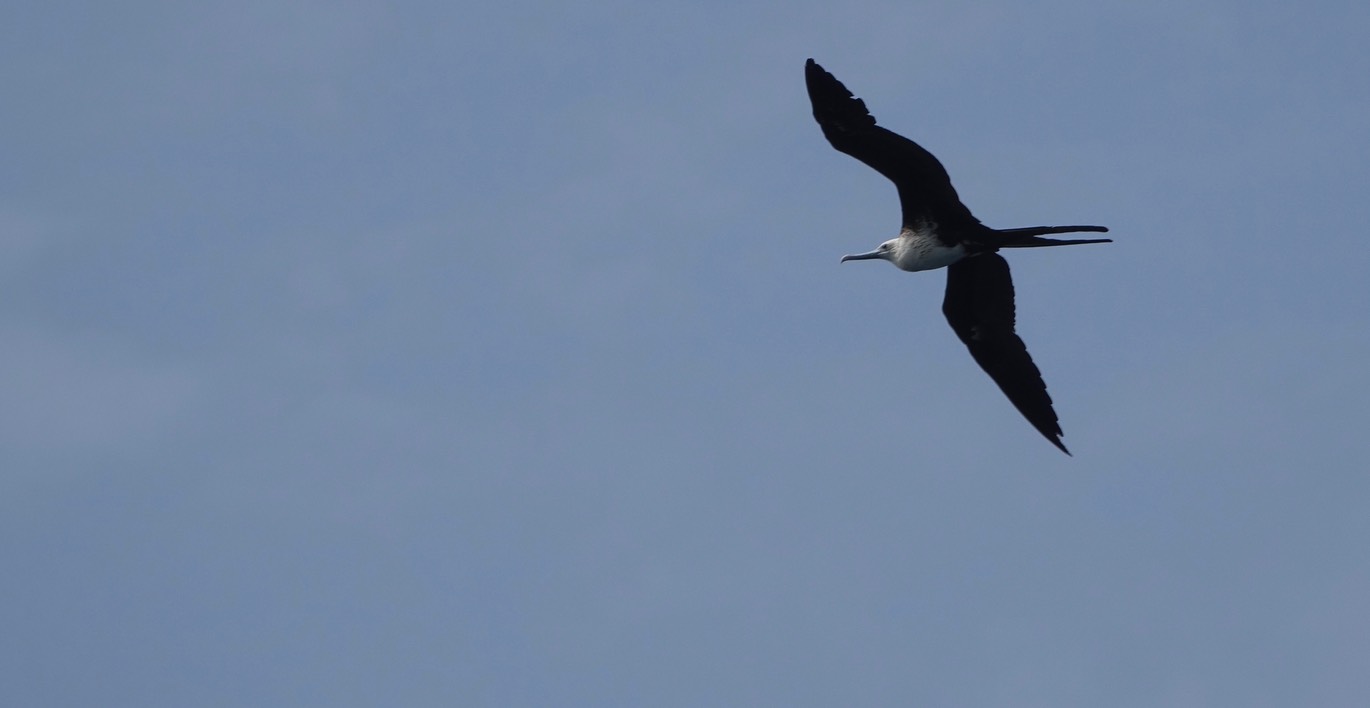
Magnificent Frigatebird, Fregata magnificens, St. Giles Island
Despite some water protection a wave crashing over the front of the boat soaked me and the camera, bricking the camera. But the view of thousands of Frigatebirds soaring above and roosting on every branch of every bush and tree is a wonderful thing to remember.
I have posted photographs from this trip to The Birds of Trinidad and Tobago and to Trinidad & Tobago. Video from this and previous trips can be found at: The Birds of Trinidad and Tobago Video Portfolio and the Travel Videos From Around the World Video Portfolio.
Greed and Markets
Being a western European type it is probably blasphemy for me to criticize market economies but I am increasingly convinced that using such systems to address our major problems will be (and has been) disastrous.
I have long been concerned about the substantial pain that humans experience and mother earth endures because of the incredibly slow response time of market economies to new realities -- not to mention those which are developing but which have not yet had an economic effect. Any large capital investment program is seriously inhibited by market mechanisms. Global warming, for instance, does not create economic disruption at the moment so market economies fail to respond to this very real threat -- in fact, those types of economies aggravate the threat, they increase both the magnitude and speed at which it is occurring. But greed, and market economies are the social manifestation of greed, is such a powerful and devious trait that humans seem powerless when confronted with this fundamental weakness of our psychic.
In the past, I have mentioned the use of Diclofenac in India and other locations, as a result of the use of this drug it is likely that remnant populations of several Vulture species will exist in zoos and captive breeding programs, but no where else. Time and time again humans make the wrong choice and all to often those decisions are made on the basis of the workings of a market economy -- and usually at the margin.
FAO reports that 75% of the crop varieties used by humans have been “lost” in the last 100 years. Corn (maize), rice, banana, and wheat are the primary food sources today and the number of traditional crops drops by the day. The replacement of traditional crops, like millet, by these economically viable crops represents a substantial risk to our species. If natural selection has taught us anything it is that the flexible survive. Our economic systems are leading to a loss of flexibility in our sources of food and in myriad other areas and as such we are doomed.
We do not have the capacity to deal with greed and the market economies that it breeds and we shall pay the price.
Building A Wall
On April 18, 2008 I wrote: I have been in Hillsboro, New Mexico (USA) for two days - continuing the long process of preparing for the relocation to here, from Portland, Oregon (USA). I spent much of the day in Las Cruces looking for a wall contractor - the one I had been talking to from Truth or Consequences not only did not show up, he failed to return phone calls. (From the future: A recurring problem of the Anglo culture in this part of the world…)
While in Las Cruces I met with a number of solar energy contractors. As I discussed photo voltaic systems with one I could not help notice a nice collection of hummingbird feeders outside his window. When I handed him my business card we wandered off into the world of birds. He is an ornithologist by training, having done his graduate work on the Galapagos Islands of Ecuador. The world is full of the periodic crossing of paths. Earlier in the day I had been discussing solar hot water systems with another contractor when I noted a number of posters and pictures of the Alaska Railroad. Alaska is not a heavily populated place but here he was in Las Cruces, New Mexico after a number of years in Alaska with the Public Health Service; across the street lives a woman who spent years in Alaska providing dental services in the bush; Rebecca and Barbara (Rebecca’s long-time best friend - who were visiting) also spent significant time in Alaska; and I spent time in Alaska as a youth and later as an adult.
Late in the day I met with the Manager of the Sierra County Electric Cooperative to discuss issues they might have with the installation of photo-voltaic cells on the house here. I gather that we will be on the cutting edge of that technology in this area. There is a home south of Hillsboro which has solar and is interconnected to the electricity distribution system. I will need to talk with the owner down there about the system they put in and the interconnection issues they may/may not have had with Sierra. Support for solar technology is mandated but the implementation of that support is something else. Electricity people are generally very conservative by nature - plus, they run a finely balanced system and have significant safety concerns for their employees. I have the impression that Sierra will be easy to work with and I look forward to the autumn and the installation of our solar systems.
A note from the future (October 12, 2011): The house south of Hillsboro mentioned above is that of Lloyd Barr and Matilde Holzwarth - who have become very good friends during the intervening period. Sierra Electric turned out to be fairly reasonable to work with but incredibly conservative -- they have a disincentive rate which has a minimum use charge (not a system or administration charge - a minimum charge on your use) which means you can produce more energy than you use and still have to pay them for electricity.
By April 24 I was writing: The building of the rock wall on the front west side of the property line begins in earnest today (by Hernandez Fencing Company of Las Cruces). Yes, we are building a wall too, just like the Bushites along the Mexican border and the Soviets in Berlin -- seems to be the thing to do. We need a rock wall along that fence line for flood control, the house is located in a flood plain and the area has flooded in the past.
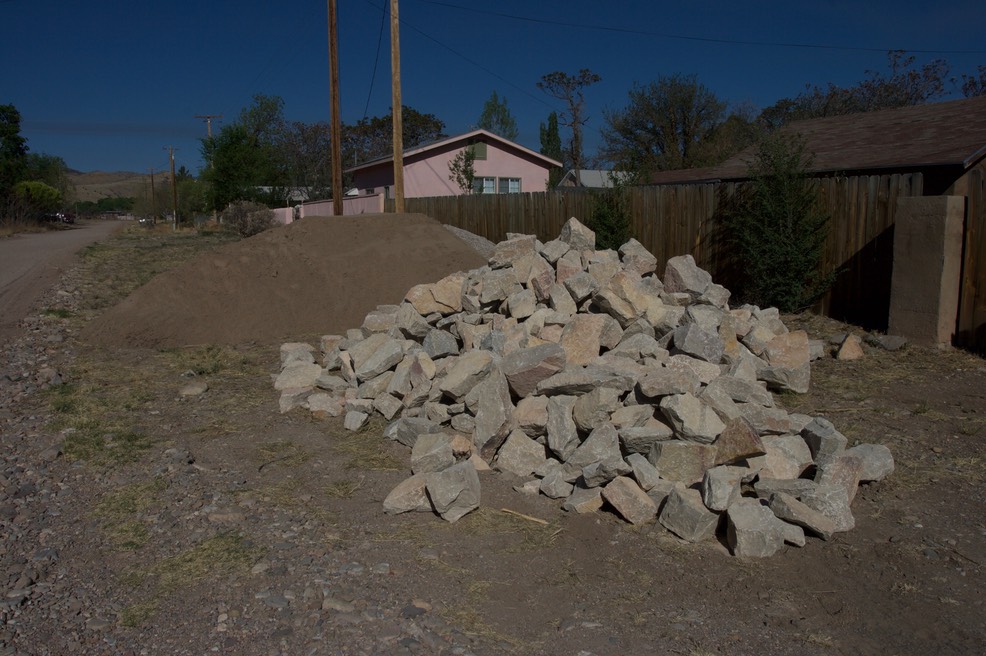
6:30 AM Today starts with two semi-truck loads of material in the back - one of wall rock and one of sand and gravel.
8:15 The air is full of chain saw sounds as they start to take out the trees in the fence line. The thud of a tree hitting the ground punctuates the call of doves and the industrial hum of the saw. The bird seed and overripe banana I put out early this morning will doubtlessly go uneaten today.
9:11 AM Three snags are down now, one had an inch of wood around the perimeter of its 18 inch (diameter) trunk - the rest was hollow. It hurts to take out these trees, in the case of the wall line they have to come out to put in the wall, in the case of the three snags - they were a real danger in the wind, and the three trees abutting the house are so close that the trunks hit the house in the wind storms. I hate the loss of habitat and solitude that the falling trees bring, but look forward to their replacement with native flora. A moment of rest for the chain saw and the doves call on...

9:37 AM The trees on the wall line (some are thirty feet high) are coming down rather quickly, about a third of the way down the wall at this time, but the remaining 2/3’s is more heavily treed. The chain saw is being replenished with fuel so it is quiet for the moment. Some tea and tamarind for Mr. Hernandez and his wife - to replace the sweat.
Amid all of the activity European Collared-Doves, White-winged Doves, Wilson’s Warbler, European Starling, and American Robin fly about.
10:27 AM The trees in the wall line in front (the larger trees) are starting to come down, most of the trees that are coming out are Tree of Heaven but there are two Elms in the wall line as well. More tea and tamarind for the saw-team.
12:00 Noon All is quiet, the work crew is off having lunch, I fell asleep in my chair, and the doves continue to call. The side yard looks like a war zone, most of the wall line trees are down to stump level and the area has really opened up (not a good thing in my opinion but necessary). Trunks, limbs, and sunlight are everywhere along the line, it is expected but I am saddened by the process.
12:20 PM Work resumes.
1:30 PM Part of the wire fence is coming out of the wall line; stumps, more wire fencing, and a few trees remain. I have been adding bags of leaves and limbs to the yard debris pile in the back, it is getting to be a very large mound. Bullock’s Oriole, Brown-headed Cowbird, Northern Rough-winged Swallow, and Say’s Phoebe are added to the yard list for a total of 33 (18 species in the yard today, a new high).
2:20 PM Looks like the workday is over. Lots done today - lots to go.
On April 25, 2008, I wrote: Fourteen bird species in the yard today, by 8:00 AM. Sixteen by 8:30 including two new yard species; Barn Swallow and Western Kingbird (bringing the yard list to 35).
10:15 The work crew has arrived with a big load of cement bags and more rock. Looks like another busy day.
12:20 More trees are down, including two of the big ones which were snug against the house. Downed wood is being hauled away and it is possible that the place will look less like a war zone this evening. One of the big trees on the corner of the house looked awfully sound (we just wanted it out because it was overhanging the house so much and Tree of Heaven is very brittle) but when it came down the center of the trunk (about half the diameter) had rotted out. More of the Tree of Heaven will have to come down - but later, all this sunlight is difficult to take.
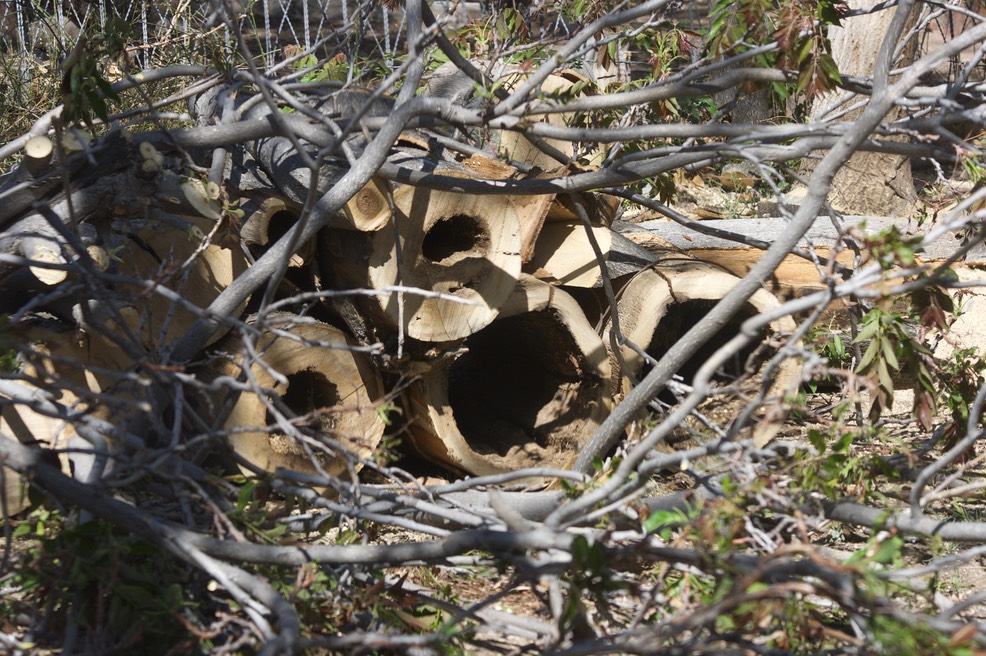
1:00 PM The crew is leaving for lunch, all of the big trees around the house are down, one or two remain in the wall line. To tie off the pull line they put a ladder on the roof to get high enough to achieve leverage. Pretty impressive undertaking.
2:30 PM Another load of branches and trunks has headed out. I have had a chance to look at more trunk sections of the big trees. Much looks like big concrete pipe in perspective, just a rim of wood and lots of hollow center.
3:40 PM The last of the trees is down, they are working on taking out stumps and hauling stuff away in the late afternoon. The crew today has been 3 - the senior Mr. Hernandez and two young men in their twenties. A great deal has been accomplished today. It seems that quite a bit remains to be done on the wall line however. The trailer has just returned, time for logs and branches to be loaded aboard. Spanish music pours from the pickup cab, it really does feel like life is different here than in Portland.
5:40 PM The work crew is back from its last load of the day and has headed home.
Added Mourning Dove to the yard list late this morning and a Great-tailed Grackle at dusk - bringing that list to 37, which I find pretty impressive. Nineteen species in the yard today, breaking yesterday’s “record” by one.
On April 26, 2008, I wrote: 6:45 AM Joe Hernandez and his father have arrived and started to work - and I have only seen 7 species this morning. They brought a small cat front-loader with them this morning so the yard is now churned up pretty good.
8:50 AM Two more crew members have shown up and trenching and stump removal is well underway.
9:45 AM Mini-disaster. While trying to get the stump out by the front wall the bobcat hit the last remaining Tree of Heaven in that quarter of the yard - there was a loud crack - it was obvious that we had to take it out as well. When it was coming down the tree trunk (about fifteen feet up) hit the wrought iron fence on the top of the neighbors fence. Bent it all to hell. Near the base the tree was about three-quarters rotted out, after the bump from the bobcat the first big wind was going to topple it.
10:30 AM They have just finished taking out the last big stump, the one referenced in the last entry. Now they are filling in the hole. Lots of bobcat work, chainsaws, shovels, and axes -- it was a devil of a trunk.
1:30 PM The crew has gone off to lunch. All of the stumps are out and the foundation of the wall is in, they start building the thing this afternoon.

3:00 PM One more big tree has bit the dust. This one a Tree of Heaven which was on the outside of the front wall, it was completely dead. The nice thing is that the stump makes a nice plant pot, it stands about 18 inches high, has an inch and a half rim of solid wood, and is completely hollow inside.
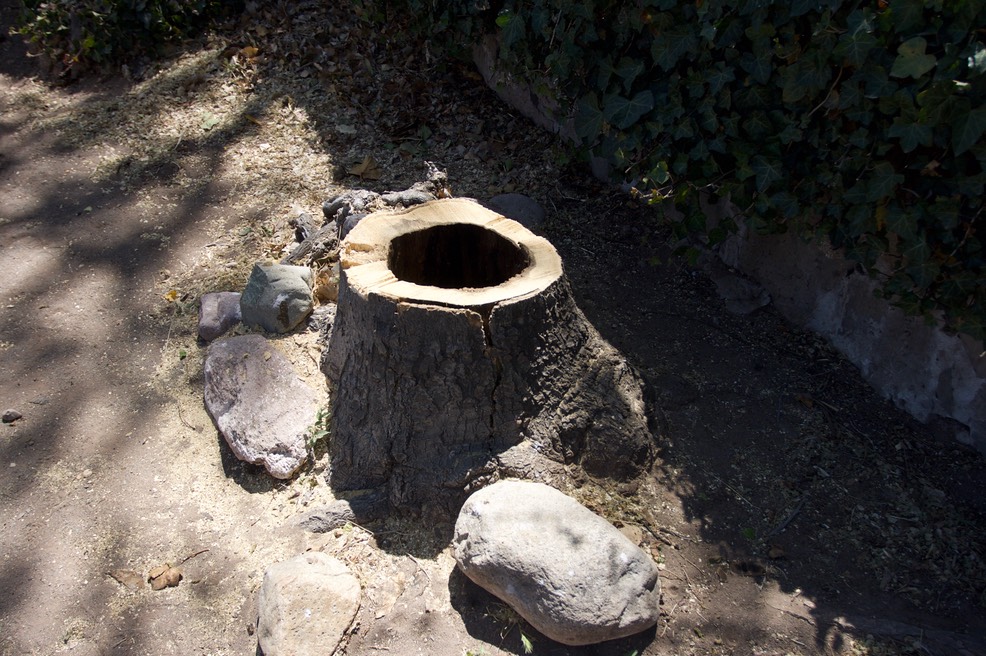
5:00 PM The crew has just left - the wall is about 20% up, I suspect they will finish on Monday, certainly by Tuesday.
On April 28, I wrote: 7:00 AM The crew has arrived, the cement mixer is tumbling, wheelbarrows are rolling, rocks are being placed and shaped, and Spanish is the language of the moment. The crew today consists of the senior Mr. Hernandez a person from yesterday and two new people, who are obviously trained wall builders.
10:45 AM The wall is about 60% up, there will be finishing work after the basic structure is in place, it is looking quite nice.
A Gambel’s Quail brings the yard list to 41.
1:00 PM They say that the wall will be complete today. The south end of the wall is almost to full height, the sides of the north end have been finished off, we are getting close - as always this crew works hard, well, and fast. The wall is 42 inches high, 18 inches wide, and 90 feet long - it will be topped with a wrought iron fence.
I have been reading more of my Google book and planning my trip back to Portland. I feel very lazy when I look outside at these guys working on the wall.
1:45 PM The basic wall is in place and most of the finish work on the east side is complete. The crew has left for lunch.
3:00 PM The crew has returned and are back at work.
4:00 PM The east side of the wall is finished, the west side is underway, and the wall is about half capped.
5:45 PM The wall is complete and clean-up is underway.

Being A Reader
I really am getting tired of writing about people dying.
One of my greatest capabilities is the ability to read. Many people share this capability with me, but this lack of uniqueness does not affect my gratitude for having the ability (an interesting concept which is worth consideration). There are a number of people who deserve credit for helping me develop that capability but the Stratemeyer Syndicate (Howard Garis, W. Bert Foster, John Duffield, and Tom Mitchell -- all writing under the pseudonym “Victor Appelton” -- the authors of the Tom Swift series) and Arthur C. Clarke certainly are at the top of the list. I devoured books by these people, all had a technological backdrop and seemed utterly plausible at the time -- and since many of their forecasts (like Clarke’s predictions about satellite communications) have materialized I suppose that was an accurate assessment. They fueled my imagination and, in the process, created a reader. Thank you Arthur Clarke.
(By the way, 25 of the original Tom Swift books are available for free download from the Guttenberg Project - under Victor Appleton.)
On March 12, 2008 I noted that I had just had an eye exam and remembered that when I was in the fifth grade I got my first pair of glasses and I remember the experience vividly. All of a sudden there was a whole new world out there, it was incredible. No amount of “four-eyes” name calling would ever get me to give up my visual aids.
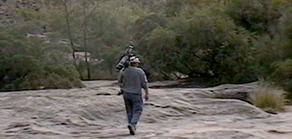
When I first started to work with a macro lens the world opened up in the same way that it had in the fifth grade. I began seeing things I had not seen before, my focus was drawn to objects I had never paid attention to. Later, with video equipment the experience was the same, but different. It was not that I saw new things it is that I saw them differently, I began to really appreciate the concept of time and motion and the perspective that they add to any image. The photo to the right is me with tripod and camera in Queensland, Australia (of the thousands and thousands of photographs I have this is one of a handful which show me).
I have always been torn between the two, the still image and the moving image -- and I am so pleased that my vision is clear with aid.
Beacons and Space
From my notes on February 28, 2008: I am hitting the road, gently I hope, since I will want to use it again. I leave behind this work of art. I call it “The Light at the End of the Tunnel”. It is not an issue of importance that it is neither a light nor located at the end of the tunnel. It is in fact, the base of an antenna pole which is at the apex of our house in Hillsboro. One of my jobs over the last few days was taking down this antenna - which had bent and was in the trees. It required a lot of roof work to get to the end of the guy wires and cut them -- all nine of them -- and the antenna had to be cut into three six foot sections and the mast separated. With the deed done, and not wanting to remove the base until we have roof work done, I looked down from above and observed that I had made a great rain gauge, the center of the mast being hollow. Sitting water on the roof was not a good idea, I thought, so I found an insulator (my range of tools and supplies being very limited) and mounted it on the mast.
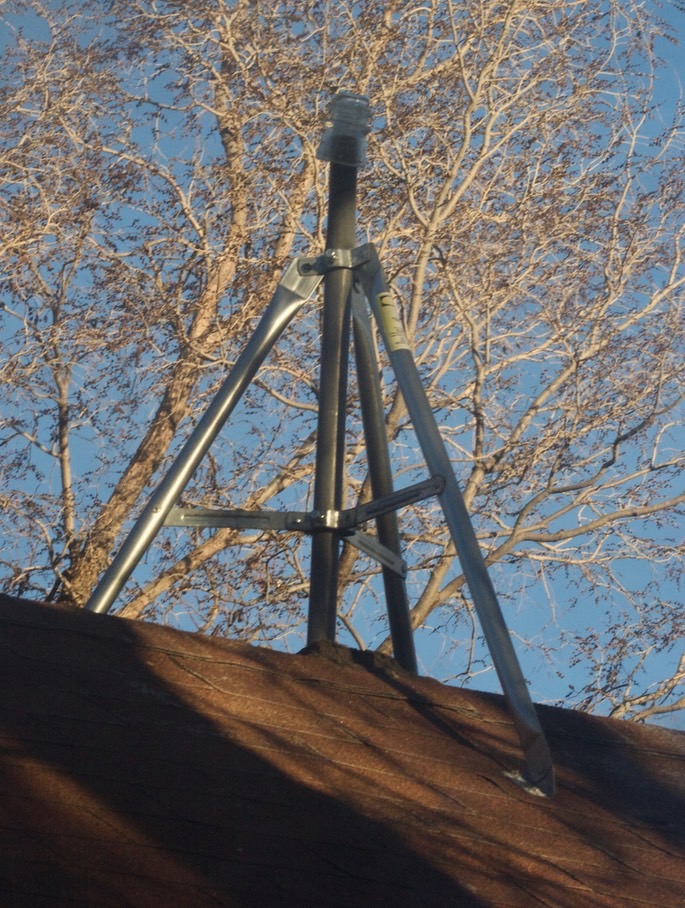
As I hit the road, I leave this beacon to call me home.
From my notes a few days before, on February 24: I drove east to Hillsboro, New Mexico -- stopping at Deming to lay in supplies. The funk returned when I heard about a neolithic idiot in Texas who shot and killed two people who were attempting to burglarize his neighbor’s house. Explaining that he had a “right to” -- it did not matter that they were unarmed and posed no threat to his or anyone else’s safety.
And lastly from March 7, 2008: Yesterday, William F. Buckley died. Although I seldom agreed with the positions he took, he was a person of intellect and I always enjoyed listening to (or reading) the rationale(s) he advanced in support of his positions. No lame platitudes from this great gentleman and no arguments at the fifth grade level - his thoughts were always to be taken seriously (and with a vocabulary which far exceeds mine - deciphered).
On April 23, 2008 I wrote: Yesterday the citizens of Sierra County, New Mexico (USA) -- my upcoming home -- voted for a tax increase to support Spaceport America, the first commercial space port in the United States. I sincerely hope that Branson and the other Spaceport America developers do not leave the people here high and dry like so many professional sport teams do - they get big tax breaks or direct subsidies for new stadiums and then leave town. I have always thought that the people in Seattle and Portland should know better but instead they went along with stadium mania and now the populace of Seattle is getting burned. Sierra County is a poor county by American standards and I would hate to see them taken advantage of in the same manner.
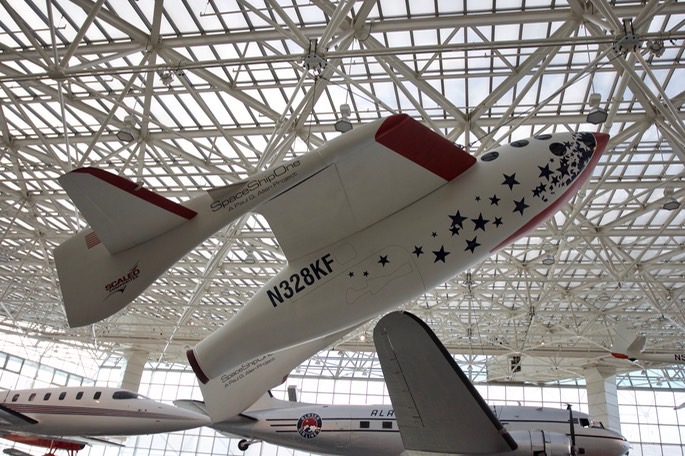
What really intrigued me about the vote, however, is the juxtaposition of cattle ranches and commercial space travel. How sublime this could be if the Spaceport America is successful, but does not lead to unrestrained development (pretty much the opposite hope of the people who voted for the tax). Space Ship One at the Boeing Museum in Seattle, above.
Wings
I first posted the following entry on February 10, 2008:
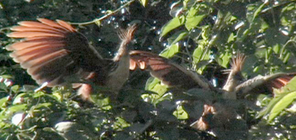
When Darwin first described the laws of evolution some of his most significant criticism came from Saint George Jackson Mivart who argued that slow continual development of structures (like wings) would be disadvantageous to a creature and natural selection would sort them out before reaching fruition. He argued, instead, that structures like wings would have to evolve completely (or nearly so) in a sudden and dramatic event. Darwin responded with the observation that structures may evolve to serve one purpose and be used for other purposes after having developed to a particular stage. Wings (of insects and birds) have long been an example around which this argument swirled. In the end, Darwin has been proven correct. In the mid-1980’s Kingsolver and Koehl published the results of their substantial research on this issue (Evolution, 1985). It had long been argued that the most likely reason appendages (which would eventually develop into wings) would start to develop would be based on thermodynamics. Koehl and Kingsolver demonstrated that this was true (that appendages would serve a significant thermodynamic benefit) and that at the point of their maximum thermodynamic capabilities (the point of diminishing returns) they were significant enough to provide aerodynamic benefits - stability during falling, “parachuting”, gliding, and eventually flying. (While continuing to provide thermodynamic benefits.) Living primitive species, like the Southern Screamer (from Brazil, pictured above) and the Hoatzin (from Peru, pictured above) also provide clues to the intersection between thermodynamics and aerodynamics. These species have “claws” at the “elbows” of their wings which allow them to climb through vegetation with greater ease. This appears to be especially useful before young birds fledge.
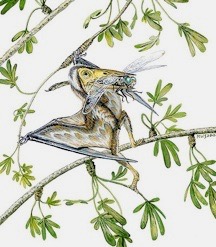
On April 3, 2008 I posted the following: I am old, and, speaking of old birds, the newly discovered fossils of the pterodactyl depicted to the right (drawing of Nemicolopterus crypticus, courtesy of Michael Skrepnickaption) are 120 million years old. This species had a wingspan of less than 10 inches (25 cm) -- or about that of a Dark-eyed Junco.
The conclusion reached by researchers is that the small beast clambered in the branches because it has curved foot bones and would tend to support the gliding before flapping camp of evolutionary biologists.
Through A Viewfinder
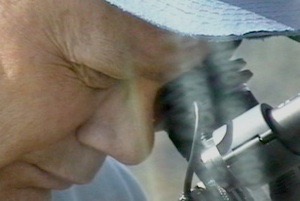
In the early 1990’s the video viewfinder I used was a crystal clear black-and-white imager which allowed for very sharp focus. It was great in low light but almost useless in the jungle where, absent movement, is was almost impossible to pick a bird out of the tangle - regardless of how brightly colored the bird was. Later, color viewfinders made it to the market and although not as sharp as the black-and-white viewfinders I could find a bird in the jungle by using them. It was something akin to watching a brightly colored Northern Cardinal fly across a clearing and into the shadows. How is it possible for something to be so obvious one moment and so obscure the next?
Like a black-and-white viewfinder, extremists view the world without the benefit of ambiguity and its nuances, they do not see the color. However, their focus is often very sharp and clear -- don’t bother me with the facts or the nuances seems to be their motto, whether they are from the left or the right.
“Now those who seek absolute power, even though they seek it to do what they regard as good, are simply demanding the right to enforce their own version of heaven on earth, and let me remind you they are the ones who always create the most hellish tyranny.” --Senator Barry Goldwater
Thank you George W. Bush, Donald Trump, ISIS, and Osama bin Laden for the inspiration for this post.
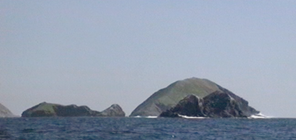
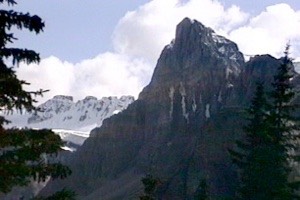
But if you throw the people away, I am reminded of the wonderful landscapes which I have been able to see on my various journeys and how diverse they can be -- I have included two shots from Alberta and one from the Coronado Islands off of Baja Mexico as examples.
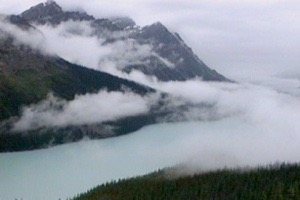
The photographs do not begin to capture the experience, off of Baja I was on a pitching fishing boat, the sun was hot, the smell of salt was everywhere. In Alberta it was sunny somedays, dark and Portland-like on others. The air and the ground was wet, and the glacial lakes were jewels set in the mountains.
Of course, jungles, deserts, ice packs, swamps, even higher mountains, and cityscapes have made it through my life as well, I have been lucky.
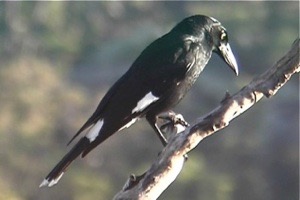
Currawong, Forktail, Cacholote, Hawk-Cuckoo, Tapaculo, Reed-Warbler, Sunbird, Hoatzen, Fairy-Wren, Trogon, Sabrewing, Drongo, Woodswallow, Honeyeater, Kookaburra, Scrubfowl, Friarbird, Brilliant, Screamer, Honeycreeper, Whistler, Butcherbird, Wagtail, Myna, Lorikeet, Shrike-Thrush, Shrike-Vireo, Stone-Curlew, Thick-Knee, Dotterel, Lapwing, Spoonbill, Mannikin, Manakin, Magpie, Magpie-Robin, Magpie-lark, Magpie-Jay, Chachalaca, Yellow-Finch, Chat-Tyrant, Cisticola, Stonechat, Xenops, Cock-of-the-Rock, Umbrellabird, Waterhen, Chilia, Chiffchaff, Cinclodes, Chilia...
I have photographed them all -- as I post more bird species in the Galleries (and the spell checker goes crazy) I am impressed with the myriad names that are given to the earth’s creatures.
Eyak Has Died & Taps
The following was originally posted on January 25, 2008:
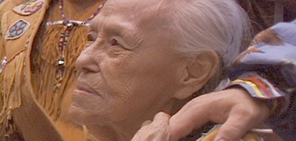
The last native speaker of the Eyak language, Marie Smith Jones (photo by APRN), has died in Anchorage, Alaska, USA. Humankind’s plummet toward uniformity continues.
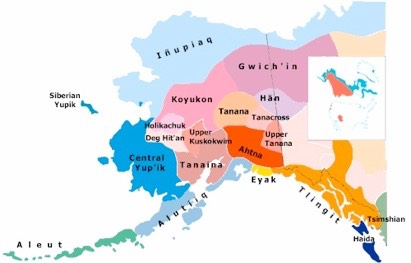
Eyak is most closely related to the Navajo language of Arizona and New Mexico, USA. The Eyak were able to maintain their culture and language despite constant pressures from stronger and more affluent language groups -- until now. In the end, English vanquished it. The map above depicts the geographic range of the various Alaskan Native languages.
The argument over the pros and cons of diversity or conformity is significant. I have long believed that language affects our ability to observe the world and ourselves -- along the lines of Peter Farb’s argument in “Word Play”. There are certainly limits to his line of argument but in the end it is more persuasive than the contrary arguments about innate abilities (as in many arguments the truth lies between the two - or more accurately, consists of both).
With the demise of each ancient language our ability to understand the world, as the speakers of that language knew it, is diminished -- perhaps absolutely. We are poorer for it. Is the advantage of common language so much more important to us?
From a post on February 6, 2008: The obsession which I have about languages and their demise is quite odd. I am incredibly poor at languages, I find them incredibly difficult -- but I recognize the significance that they have for the human condition. When I first read Kafka’s Metamorphosis, in German, I was struck at how much more rich it was than any English translation -- even for something as simple as gender based pronouns.
***

Posted on March 11, 2008: Yesterday, Rebecca and I attended the funeral of a friend. It was the first time that I had heard the report of the honor guard and Taps since the burial of my father.
Day is done, gone the sun
From the hills, from the lake,
From the sky.
All is well, safely rest,
God is nigh.
Yesterday, a granddaughter -- Miss Sophia -- came to visit, at four she is full of energy, charm, and playfulness.
A Few Book Reviews
The following entries are a few book reviews published on May 13, 2014 on the www.bobbarnes.us website.
Reviews From the Past
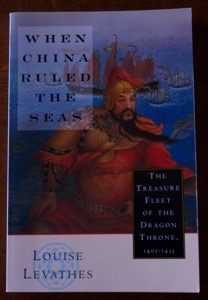
I have finished reading "When China Ruled The Seas" by Louise Leavathes. Her take on the issue of the great Chinese Treasure Fleets is more conservative than that described in 1421 and she dwells on the dynamics of Chinese society to a greater extent. After reading these different interpretations I surmise that the truth lies in the middle with the likelihood that the description in 1421 is more likely to develop a solid base than it is to contract dramatically. It is fairly well documented that the Chinese were traveling to Africa, India, Arabia, and Australia very early -- much earlier than the last of the great Treasure Fleets. That should not be surprising, but to take those early contacts as a diminishment of Columbus, Cook, et. al. is a serious mistake. The question is not who got there first, the question is what happen afterward. In the case of the Chinese, their early contacts in Australia probably went on for centuries and that is significant, their trade with Africa and India was significant, and their probable contacts in the "New World" are significant. All of those accomplishments lead to the spread of Chinese knowledge and technological advancements - things that the Arab and European worlds used as foundations for their achievements in the 15th century to present.

***
I have finished reading Gavin Menzies book entitled "1421 - The Year China Discovered America". The book certainly has its detractors but I suspect that Menzies got much of it right. He seems to overreach at times, draws conclusions which clearly do not follow the evidence, gets the facts wrong at times, and is prone to making assertions (rather than developing evidence) at the most unfortunate times. Given all of that, however, it still seems that the basic premises of the book are most likely correct and the details may not matter that much. His detractors, from a web search, sometimes attack the facts as he presents them but seem to more likely to attack his character - which does seem suspect - and in so doing demonstrate some fundamental weaknesses in their arguments.
***

I have just completed “1493" a new book by Charles Mann. This is a follow-up to his book 1491. The professed purpose of the two books is to bracket the Columbus' trip to North America in 1492. In “1491", Mann discussed what the state of affairs were in the Americas prior to 1492 - finding populous cultures which intensely modified their ecosystems for agriculture. In what is now the east coast of the United States there were sophisticated cultures which had made major modifications to the "forests" of that area for agricultural purposes, for instance. In “1493", Mann sets out to describe the ramifications of the transfer of goods to and from the Americas.
I found the discussions of China interesting. I had long known the socio-political changes created in Europe by the introduction of a few varieties of potato. I had not known that a similar situation developed in China, primarily because of the introduction of the sweet potato and maize. I also found the chapters about the African settlements, infused with the indigenous peoples and escaped slaves, which developed throughout the Americas - but mostly south of what is now the US, to be interesting.
Not as "exciting" a read as 1491, but interesting none-the-less. Discovering major historical events (not mere tidbits of history) of which I was unaware is always very pleasing to me. It gives me a sense that I am still learning.
As for a historical tidbit, my son Jon recently sent me a note about "Y-12", the World War II uranium enrichment facility at Oak Ridge, Tennessee. It seems at start-up there was a significant shortage of copper so the electromagnetic coils were made with 14,700 tons of silver borrowed from the West Point Depository of the US Treasury -- and returned after the war.
***
This review was republished on May 19, 2014.
Henry Walter Bates

I have just finished reading "The Naturalist on the River Amazons" by Bates - as an e-book (free from Amazon.com). On January 15, 2009 (Bob's Birding Blog at The Birding Commons), I wrote about Alfred Russel Wallace -- Bates collected with Wallace in the Amazon before Wallace went off to Malay. All in all, Bates collected in the Amazon for more than seven years, accumulating specimens of more than 14,000 species (more than 8,000 of which had not been previously described). Most of his time there was spent under the most primitive conditions. His biological insights were significant -- his cultural insights, well he was a stereotypical European of the time - convinced that European everything defined the civilized world.
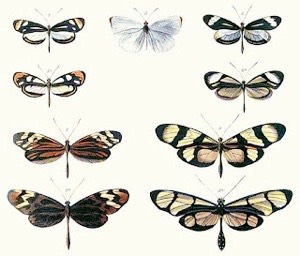
His work with the butterflies of the Amazon (he was primarily an entomologist) led to his description of mimicry (the first description of this concept) and especially what is now known as Batesian mimicry (a palatable species mimicking an unpalatable species). A plate from his 1862 paper, "Contributions to an insect fauna of the Amazon Valley - Heliconidae" is shown here.
For those who read the book, he describes several places which are known known by different names. Namely, Pará is now named Belém and Ega is now named Tefé.
***
The following reviews were first published on The Birding Commons blog in April of 2008.
Stephen Jay Gould’s Imperfection
I have just completed Gould’s collection of essays - “The Richness of Life: The Essential Stephen Jay Gould”. Gould had an incredible mind, an appreciation that his readers were not in the sixth grade of grammar school, and a nice wit. But now I have discovered an error. My, oh my. In the last essay of the book “Hooking Leviathan By Its Past” he posits that the scientific names of species are static (discussion in his case two). One of the greatest pains that I face (that is obviously hyperbolic) is trying to keep pace with the constant changing of genus names in ornithology -- causing me to be unreceptive to the statement. Shades of great loss, I feel like I did when I met Sir Edmund Hillary and found him to be a cordial tall man, not some type of super hero. With his later work in the Himalaya for the Sherpa people he became a super hero, but I knew him only as the “conquerer” of Everest. And now Gould…
More Gould
Last night I was reflecting on some of the general themes in Gould’s essays; science and society, the duality of humankind, American fundamentalism (a breed of anti-intellectualism peculiar to the United States), and the multiple processes of evolution. One of his major themes was the struggle to use scientific thought appropriately and for appropriate matters. The first part of this theme is based on his strong conviction that science is amoral the second part addresses the misuse of science (a question of morality). He deals with the suppression of scientific thought and genocide extensively when exploring this theme.
The suppression of scientific thought is an interesting political phenomenon. (Gould never, to my knowledge, expressly describes it in that manner.) I have always thought of such efforts as extensions of power struggles, fundamentally new thoughts and concepts are often threatening to the power in place and are, therefore, resisted. Those same power structures are, all to often, willing to justify their actions as consistent with their interpretation (however inaccurate - but always self-serving) of some scientific concept. Gould focuses primarily on ideas like “social darwinism” when he discusses the misuse of scientific thought and in the process brought to my attention something I had never really considered, at least in a structured manner. He posits that the change in societies is Lamarckian in nature and not Darwinian. It has always been obvious to me that societal change is not Darwinian. I find the idea that societal change is Lamarckian in nature both intriguing and probable. Lamarck’s concept of evolution was that traits that were developed (not inherited) could be passed between generations. This idea fell prey to Darwin’s description of natural selection as a dominate process in the evolution of biological entities. I find it quite elegant and more than a bit ironic that concepts of natural selection are continually applied (inappropriately) to changes in societies when, in fact, it is the Lamarckian concept (the failed biological premise) which is most appropriately applied. Changes in societies are based on learned concepts and passed from one generation to the next through social processes, these concepts deal mostly with a society’s thoughts about morality. The attempts by power brokers to justify their actions (bigotry, genocide, social engineering in general, economic dominance, etc.) by citing biological science is hypocritical at best (not the worst of their sins). The proper “justification” of their actions lies in the realm of morality, something they must take personal responsibility for -- it is not an inherent weakness of the species.
The second theme he discusses frequently is the mixed record of the human species. Here he distinguishes between capability and use. The human mind is capable of great and honorable achievements, it is also capable of incredibly destructive acts. The mind evolved to its present state over a relatively short biological timeframe. It is not provable, at his point, that their are inherent dispositions toward certain sorts of actions. There are strong assumptions about various concepts (nurturing, for instance) and they are sound in theory (to a point) but we lack the ability to “prove” them one way or the other. (Nurturing is an interesting example. In the human species it is required for survival, that seems apparent. But many pundits then carry the concept further to try to ascribe a different basis for nurturing to the two sexes and to even extend their argument to biological developments of social norms in our pre-history - something which is not provable and not worth the conjecture in the first place.)
The third theme, American protestant fundamentalism, as an anti-intellectual practice, is akin to the first theme above. It is about power and the way some people think the world should be - and damn the facts. In one of his essays he notes that the Catholic Church accepts the concept of evolution and natural selection without much issue and that the Kansasian tendencies of protestant fundamentalism are almost singularly American in practice.
The last major theme that I focused on in Gould’s work is the multiplicity of processes which are at work in the evolutionary process. (As a side note, Gould stresses time and time again that the evolutionary process is not directed toward advancement, it is a process of adaptation to a current environment.) Natural selection is the premier biological process at work but there are others. For instance, there are constant random changes to DNA which have no inherent positive or negative affect -- they just happen and they are there. At some point in the far future they may become positive or negative, but at the point of development they are neither. There are also non-biological events which change the evolutionary stream of many species. An asteroid hitting the earth, for instance, led to the demise of the largest reptiles. A chemical spill in a stream can whip out an entire species. There are many examples of events which dramatically change the environment in either an immediate or relatively short time frame (globally warming is receiving a lot of attention at the moment). The adaptations which biological entities may have developed may or may not be able to cope with these dramatic environmental changes.
Gould’s endorsement of concepts like random neutral changes to DNA and the role of chance events enhanced the understanding of evolutionary change. He is most known for his concept of punctuated equilibrium, however. This concept posits that the evolutionary process moves along in its slow but sure manner for millions of years but periodically (in geologic terms) there will be a period of significant change. This fluctuation in the rate of change is well established in the fossil record and may or may not be associated with dramatic events like asteroid strikes or longer term changes like the diminishment of the continental shelve area on the earth as continents drifted together. He was a significant force in the biological sciences and a strong advocate for basic decency in human dealings. His death is a significant loss to humankind.
Google.pedia
Jon gave me a book my Michael Miller, “Google.pedia The Ultimate Google Resource”, for my birthday and I have been reading it in an unstructured manner. Today I read a chapter about the Google Scholar program - a Google search engine for more scholarly research on the web (it has the advantage of citing material which is not on the web as well as that which is). The Google Scholar portal contains the familiar “stand on the shoulders of giants” phrase. I was reminded, in a backward sort of way (by a Gould essay), that “survival of the fittest”, a phrase which is inherently associated with Darwin, did not originate with Darwin. Instead, it is a phrase from Spencer - coined a decade before the publication of the “Origin of Species”. It is often misunderstood to refer to a battle to the end. Darwin accepted the phrase as a descriptor for natural selection after Spencer and others used it widely to describe the Darwinian process. However, Darwin always described natural selection in terms of “survival of the best fit”, evolution is about adaptation.
There was work similar to Darwin’s going on at about the same time that he was developing his description of natural selection: Lamarck was trying to address the same question that Darwin was researching but came up with the wrong answer; work in geology, paleontology, and genetics were also ongoing. Bits and pieces of all of these efforts were known to Darwin and helped, in the very least, to predispose him to his successful description of the evolutionary process. It is, I believe, like this in all fields - I don’t know of any discovery which was made from whole cloth, which was totally original. We all stand on the shoulders of those who came before us.